
 Posted By :
Michael Speyer
9 Feb
Posted By :
Michael Speyer
9 Feb
Default Crisis Posture
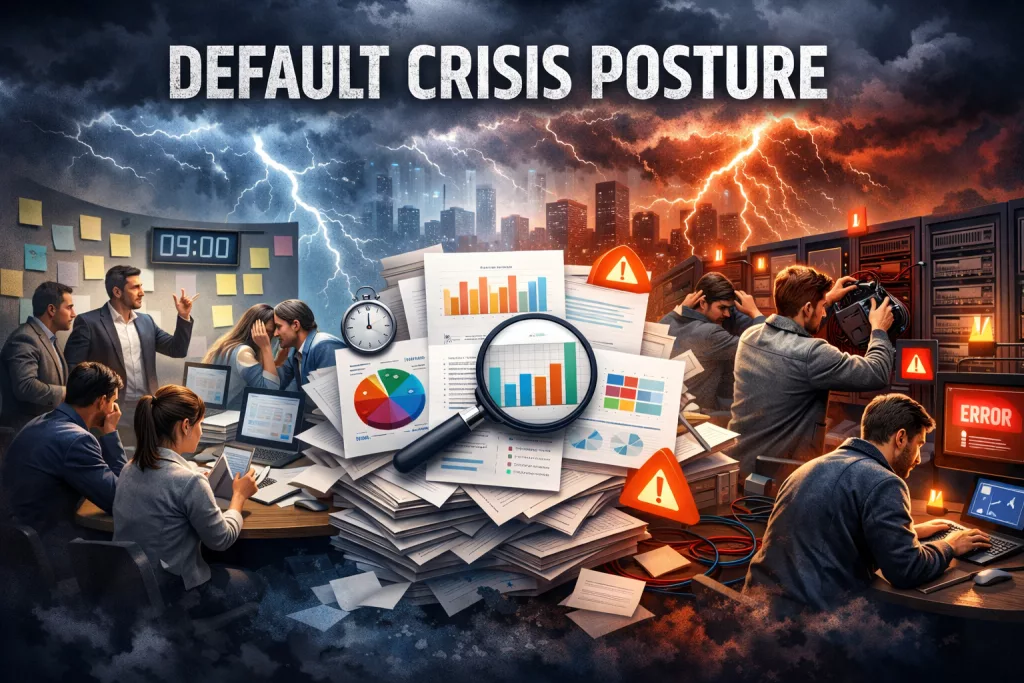
Every IT organisation has one, whether it is written down or not – a reflexive, almost ritualised response to operational failure.
A major incident lands. A service degrades. Customers complain. Senior attention snaps into focus. And within hours, sometimes minutes, the organisation falls into its default crisis posture.
It is rarely questioned. It feels active. It looks decisive and in many cases; it actively makes things worse.
The Familiar Pattern
The default posture typically manifests in three predictable moves.
First: meetings multiply.
Daily stand-ups are arranged. Then twice-daily. Then ad-hoc “temperature checks”. Attendance grows with each iteration, as if proximity to the problem itself were a form of progress.
Second: reporting explodes.
New granular reports are requested at speed. Metrics that did not exist yesterday are demanded by tomorrow morning. Data is sliced, re-sliced, colour-coded, and circulated. The assumption is implicit: insight must be hiding somewhere in the numbers, if only we zoom in far enough.
Third: labour is redeployed chaotically.
Subordinates are asked to drop their normal duties. Engineers, analysts, and managers alike are pulled into “helping”, often without clear objectives. People begin pulling levers – restarting things, tweaking configurations, escalating vendors – not because there is a hypothesis to test, but because something must be done.
This posture is so common that it feels natural. Sensible, even.
But it is largely theatre.
Why This Happens
Default crisis posture is not born of incompetence. It is born of discomfort.
Operational crises create a vacuum: of certainty, of authority, of explanation. Leaders feel pressure to demonstrate control. Visibility becomes conflated with effectiveness. Activity becomes a proxy for progress.
Meetings reassure leaders that the issue is being “taken seriously”.
Reports reassure them that the problem is being “understood”.
Reassignment reassures them that “all hands are on deck”.
None of these guarantees that the problem is being solved.
In fact, they often delay genuine resolution.
The Hidden Costs
The most obvious cost is cognitive overload.
Daily stand-ups fracture attention. Engineers stop thinking deeply and start performing updates. The problem is discussed more often than it is analysed. Nuance is lost to timeboxes and action lists.
The second cost is data dilution.
When new reports are demanded under pressure, they are rarely well-designed. Definitions drift. Numbers are produced without context. Teams argue over whose data is “right” instead of why the system is behaving the way it is.
The third cost is systemic blindness.
By pulling people off their day-to-day responsibilities, organisations create secondary failures. Monitoring degrades. Preventative work halts. Knowledge silos deepen as specialists are reassigned into generic “war room” roles.
Ironically, this can generate new incidents while attempting to fix the original one.
Activity Versus Understanding
The core flaw in such a default crisis posture is the assumption that speed equals effectiveness or noise equals progress. It simply doesn’t.
Complex systems do not yield their causes on command. Many operational problems take time to reveal their shape. Data needs to be observed longitudinally. Behaviours need to be correlated. Environmental factors need to be ruled in or out.
Doubling the number of meetings does not halve the time to understanding.
Requesting more granular reports does not guarantee better insight.
Adding more people does not necessarily add clarity.
In some cases, it actively removes it.
A More Disciplined Alternative
A healthier crisis posture looks quieter from the outside.
It starts with clear ownership, not collective anxiety. One accountable lead, empowered to make decisions and protect the team from noise.
It limits meetings ruthlessly. One structured forum with a defined purpose: hypothesis review, not status theatre.
It demands fewer reports, not more. Existing data is examined properly before new metrics are invented. Definitions are agreed once and held stable.
It protects core operational work. Only those with specific, relevant expertise are pulled in. Everyone else continues keeping the lights on.
Most importantly, it embraces the uncomfortable truth that understanding often lags impact. That is not failure; it is reality.
Why This Is Hard
This posture feels counter-intuitive under pressure.
It can look passive. Calm can be mistaken for complacency. Silence can be mistaken for inaction.
But discipline in a crisis is not about appearing busy.
It is about preserving the conditions in which real diagnosis can occur.
Organisations that repeatedly default to noise, motion, and disruption do not fail because they lack effort. They fail because they cannot tolerate uncertainty long enough to actually learn.
Final Thought
Every organisation should ask itself a simple question:
When the next operational crisis hits, do we default to understanding – or to activity?
The answer is rarely flattering.
But it is one of the most honest indicators of operational maturity you will ever find.